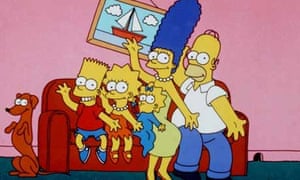
A closer look at the inner dynamics of the American classic television show
Fiona Kenyon
A Little Context…
In 1989, the first episode of television show The Simpsons aired. It is has not stopped running since. It has remained arelevant part of American culture for almost three decades, with ratings as good as ever, and a target audience that seems to be everyone. The reason for the show’s success, is that through its parody style portrayal of the Americanfamily, coupled with its satirical commentary on both neutral and adverse topics such as religion, politics, and economics, it has remained relatable and relevant to most viewers today.
When talking about The Simpsons, it is important to have a general definition of several key terms. The first term being satire. According to the Oxford English Dictionary satire is “the use of humor, irony, exaggeration, or ridicule to expose and criticize people’s stupidity or vices, particularly in he context of contemporary politics and other topical issues,” this is a satisfactory definition. In her article, “American Cartoons: the Image of Interpersonal Relationships in South Park and The Simpsons,” Jana Brandon, points out the importance of the type of satire used. The Simpsons uses a form of satire known as Horatian satire (9,Brandova). This means that it “reveals the truth with a smile” rather than cynical cruelty towards its characters as a form of commentary, also known as Juvenilian satire (9, Brandon). The other important definition to note, is what a parodyis. The Oxford English Dictionary defines a parody as, “an imitation of the style of a particular writer, artist, or genre with deliberate exaggeration for comic effect.” The Simpsons employs both satire and parody in its episodes with the purpose to entertain, but it also provides a platform by which the creators can produce commentary on present day issues without burdening viewers. As David Feltmate, in his article, “It’s Funny Because It’s True? The Simpsons, Satire, and the Significance of Religious Humor in Popular Culture,” he explains that the show is a satirical parody. By this he means it is a, “[depiction] which reference[s] other cultural phenomena for critical purposes.” This is important to keep in mind when discussing the show.
Politics

The show depicts a parody of many issues, in particular its take on politics has made it extremely influential at times.
It’s All in the Family
Paul Cantor in his article, “The Simpsons: Atomistic Politics and the Nuclear Family,” explains that the approach the show uses to discuss politic is through family “and this in itself is a political statement,” (735). The reason for this is that, “[b]y dealing centrally with the family, The Simpsons takes up real human issues everybody can recognize and thus ends up in many respects less ‘cartoonish’ than other television programs,” (735 Cantor). He explains that while critics of The Simpsons discredit the show for its disrespectful portrayal of family values, it actually reaffirms the importance of the traditional nuclear American family. This is opposite of the television norm, Cantor argues, because since the 1970s, Hollywood has done its best to represent other family dynamics than nuclear. He cites Alice, My Two Dads, and Party of Five, all produced between 1970 and 1990, as examples of shows that deviated from the traditional family portrayal. Party of Five being the most extreme example, as there are no parents in the show whatsoever (Cantor). The message these television shows portray is,“that the breakdown of the American family does not constitute a social crisisor even a serious problem…it should be regarded as a form of liberation from animage of the family that may have been good enough for the 1950s, but is nolonger valid in the 1990s,” (737, Cantor). Meanwhile, The Simpsons aired its first episode in 1989, with a return to the traditional nuclear family and an opposing message than the majority of television at the time.
“The key to parenting is don’t overthink it. Because overthinking leads to … what were talking about?” -Homer Simpson
Insane Clown Poppy, s12e03

Cantor’s argument is not that The Simpsons is unique by focusing around a family; other shows like The Cosby Show and Married with Children, to name a few, preceded The Simpsons. Rather, it is the way in which the creators combine “traditionalism with antitraditionalism” (737, Cantor). The result of which is that it perpetually “offers an enduring image of the nuclear family,” while also mocking it through satire (737, Cantor). Fundamentally, the message that persists is the value of the nuclear family, because it is the foundation upon which the rest of the show builds. Cantor makes his case around Homer Simpson, who he says is “the distillation of pure fatherhood,” (739). Despite his poor behavior and selfish tendencies, he cares for his family,which is evident through his dangerous job at the nuclear plant (739 Cantor). Cantor conveys that it is the act of caring and trying one’s best for their family, isthe glue that holds the nuclear family together. What constitutes a happy and successful family has long been disputed in America, and currently there is noone ideal family structure. However, The Simpsons does provide an interesting take on the debate. Its satirical representation of the American family neither condones other family structures, nor praises itself, but the very fact that it is relevant in the show, is what keeps it relatable and of interest to the public.
Satire and Religion
Of importance to note is “that when The Simpsonssatirizes something, it acknowledges its importance,” (742 Cantor). This is evident in its parody of the many current issues, including religion. The show has been criticized for being against the institution of religion, but it actually is satirizing it to identify its significance and the real world problems related to it (Cantor).

The dichotomy between Ned Flanders’s family and the Simpsons is indicative of the larger problem of loss of faith. Ned and his family are extremely pious, to the point of being a nuisance to even the Reverend Lovejoy. However, the Simpsons also regularly attend church, the difference being that Homer represents the masses of Americans who attend church, but do not feel religious or spiritual. In the same vein, Reverend Lovejoy “deals realistically and rather sympathetically with the problem of pastoral burnout,” (742, Cantor). In the episode, In Marge We Trust, he resigns from his job as reverend because he has finally become overworked and cannot bare to listen to his parishoner’s problems anymore, so he turns the position over to Marge. The episode is of course comedic, but this is a common issue for pastors.
“I’m not a bad guy! I work hard, and I love my kids. So why should I spend half my Sunday hearing about how I’m going to Hell?” -Homer Simpson
Homer the Heretic, S04e03
While critics are quick to accuse the show of being anti-religion and/or disrespectful of religion, nothing could be further from the truth. On the contrary, “judging by most television programs today, one would never guess that Americans are by and large a religious and even churchgoing people,” (741 Cantor) however, The Simpsons is one of the few shows to actually reflect the significance religion plays in people’s daily lives. The reason, religion is not often depicted in television is due to several factors, chief among them being that, “[p]roducers are afraid that if they raise religious issues, they will offend orthodox viewers and soon be embroiled in controversy; television executives are particularly worried about having the sponsors of their shows boycotted by powerful religious groups,” (742, Cantor). The Simpsonschooses to embrace the significance of religion to Americans. The conscious decision to depict difficult, but everyday issues, is what keeps the show one of the most relevant to date.
The Simpsons as an Art Form?

Stylistically, the show is made in the post modernist style, Henry Keazor argues in his article ““The Stuff You May Have Missed” Art, Film and Metareference in The Simpsons.” The basis of post modernist art is that it critiques the larger institutions that it exists in. It takes inspiration from the comic strip Life in Hell, a cartoon made by Matt Groening. The first episode was aired on The Tracey Ullman Show, and the animation was much different from the clean animation style it is currently (473 Keazor). After time, it eventually evolved into what we we know today which is “a vigorous re-interpretation of the perceptual world by establishing and using its very own graphic system of representation, which depicts humans mostly with yellow skin, large oval eyes, big mouths displaying an overbite, four fingers, and very distinctive hairdos,” (466 Keazor). Keazor then goes on to explain that, “the aspired aim here is not to render a (photo)realistic, highly mimetic and illusionist representation,” or even, “an approximatelyrealistic representation,” (466). In fact, in the episode “Lady Bouvier’s Lover” Homer imagines his family as though they were animated realistically, but finds the thought awful, much preferring their normal look. The purpose of postmodernism style in the show, Keazor argues, is to more effectively provide critiques and commentary on topical issues. However, by producing its own style, it has become a style which other shows take reference from. Keazor says, “while before The Simpsons quoted art, now art is quoting The Simpsons,” (487). He is not wrong in saying this; later shows such as Family Guy and King of the Hill, all take their influence from The Simpsons. The animation style, is yet another example of how The Simpsons has made itself a relevant an ingrained part of American culture.
All In All
The Simpsons has become so much a part of pop culture today, that the creators must be conscious of the values and morals it upholds. However, through its tactful use of satire, it is able to do what other television programs are hesitant to do, and discuss all manner of topics from religion to politics. The show makes a point of addressing all topical issues, in this way it is relatable to a larger global population than just America. Simultaneously, through its satirical use of the nuclear family in particular, it is a biting reflection of the traditional American way of living. It is in these ways that The Simpsons provides content that is relatable and relevant to all audiences.

 We Stan Maggie Simpson